Everyday carry is not about filling your pockets with gear you will never use. It is about choosing a small number of items that quietly make your day smoother, safer, and more capable — and carrying them with intention.
The phrase "everyday carry" has been adopted by communities that sometimes confuse preparedness with accumulation. More tools do not make you more prepared. The right tools, carried consistently and understood completely, do.
This guide is for the woman who is beginning to think about what she carries and why — whether for practicality, safety, or simply the quiet confidence of being ready for the ordinary moments that make up a real life.
What Everyday Carry Actually Means
Your everyday carry is the collection of items you have with you nearly every time you leave your home. It is not a bug-out bag. It is not a survival kit. It is the small set of tools, essentials, and personal items that support the life you actually live on a typical Tuesday.
A good everyday carry system answers a simple question: what do I genuinely need on an average day, and what would I regret not having?
The answer is different for everyone. A woman who commutes into a city by train carries differently than one who drives between appointments. A mother of young children carries differently than a woman who travels for business. The goal is not to copy someone else's list. The goal is to build systems around the life you actually live.
The Five Categories of a Woman's EDC
Rather than thinking in terms of individual items, it helps to think in categories. A balanced everyday carry kit covers five areas: identity and payment, light and utility, personal care, communication and information, and personal safety.
You do not need to carry something in every category on day one. But understanding the framework helps you make deliberate choices instead of accumulating items without purpose.
1. Identity and Payment
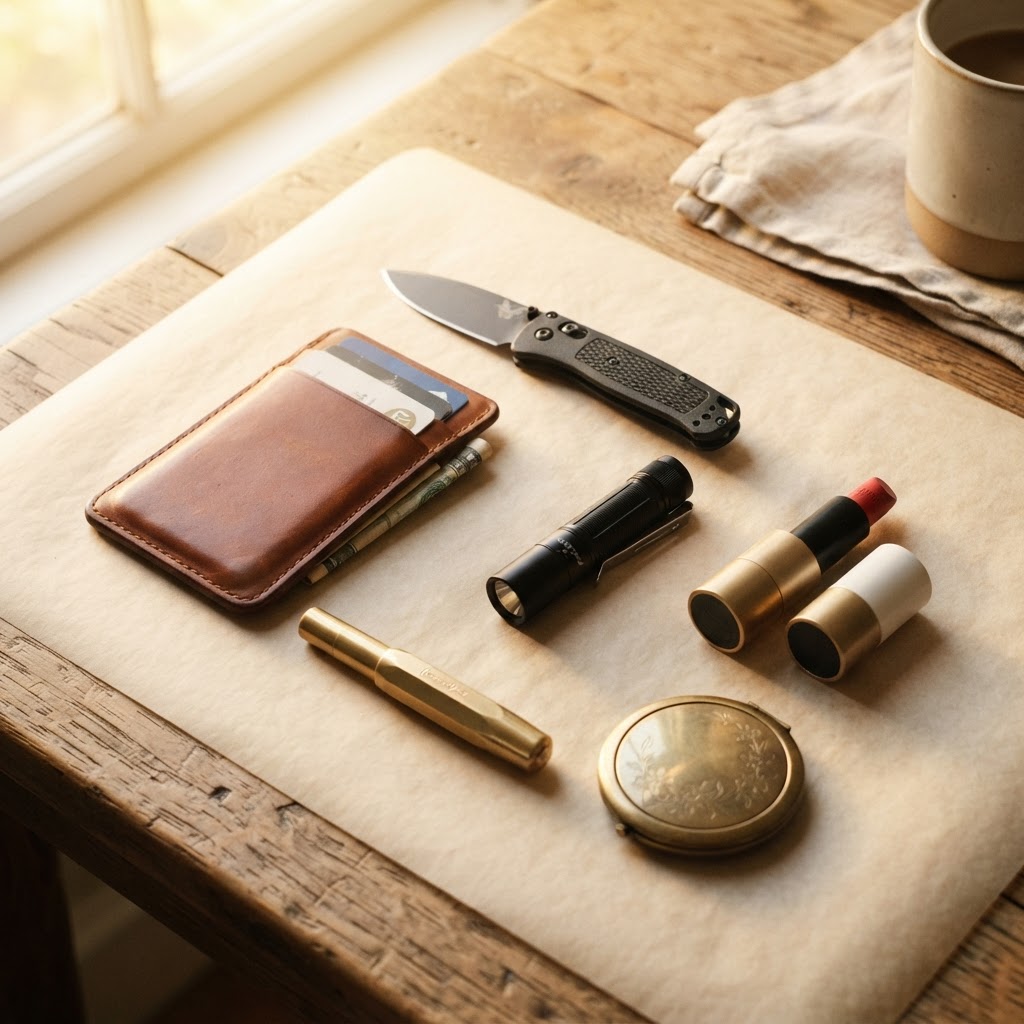
This is the foundation. A slim wallet or card holder with your primary identification, a debit or credit card, and a small amount of cash. Keep it minimal — a bulky wallet is the most common source of unnecessary weight and bulk in a woman's carry.
If you carry a bag, you might add a secondary form of identification. If you do not, ensure your primary ID is always with you. The goal is consistency: the same items in the same place every day, so you never have to wonder whether you remembered them.
2. Light and Utility
A small flashlight and a pocket knife are the two items most overlooked by women and most appreciated once carried. A compact flashlight — smaller than a lipstick — lives in a pocket or bag and is useful far more often than you would expect. Reading a menu in a dim restaurant, finding something dropped in a car, walking to your vehicle in the evening.
A pocket knife is the hardest-working tool you can carry. Not for self-defense, but for the everyday tasks that quietly add up — opening packages, cutting a tag, trimming a loose thread, opening a letter. I wrote more about this in Why I Carry a Knife Every Day, but the short version is this: once you carry one, you will wonder how you managed without it.
Choose a small, quality knife that opens smoothly and locks reliably. A knife you are comfortable using is worth far more than an impressive one that sits unused.
3. Personal Care
This category is personal, and it is where luxury and preparedness meet most naturally. Lip balm, a compact mirror, a tissue or two, a breath mint, and perhaps a small tube of hand cream. These are the items that let you move through your day with quiet confidence — refreshed, composed, and unhurried.
Keep them in a small pouch or dedicated pocket. The point is not to carry a cosmetics bag everywhere. The point is to have the few items that matter to you within easy reach, so you are never searching or settling.
4. Communication and Information
Your phone is the center of this category, but consider what supports it. A charging cable or small power bank, a pair of earphones, and perhaps a small notebook and pen for the moments when writing something down is faster and more reliable than typing it.
A brass fountain pen and a slim notebook take up almost no space and elevate the simple act of capturing a thought. I keep mine nearby always — not because I do not trust my phone, but because some ideas deserve a slower, more deliberate kind of attention.
5. Personal Safety
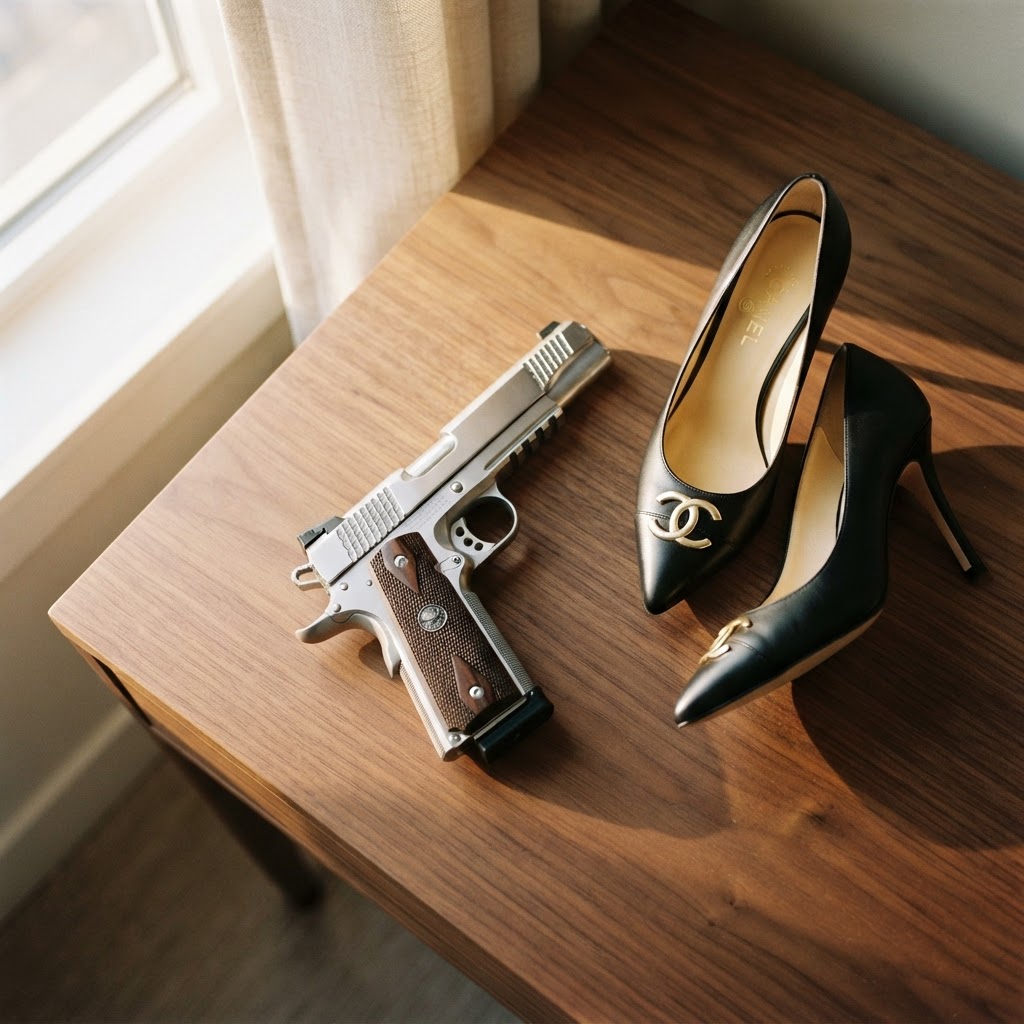
This is the category that means different things to different women, and it deserves honest reflection. For some, personal safety means a small canister of pepper spray carried in an accessible pocket. For others, it means a personal alarm, a self-defense keychain, or the decision to carry a firearm.
If you are considering carrying a firearm, that decision deserves its own careful process. I wrote a separate guide to Choosing Your First Handgun, and I would encourage you to read it before making that choice. Training, legal understanding, and honest self-assessment come before the purchase.
For every woman, personal safety also means situational awareness — the practice of paying attention to your surroundings, trusting your instincts, and positioning yourself deliberately. No tool replaces that.
How to Choose What to Carry
The most common mistake when building an everyday carry kit is starting with someone else's list. You see what a blogger or a friend carries, and you try to replicate it. The result is a collection of items that may be excellent on their own but do not fit your life.
Instead, start with a week of observation. Pay attention to the moments when you wished you had something — a light, a knife, a pen, a bandage. Write them down. After a week, patterns will emerge. Those patterns tell you what belongs in your carry.
Then apply a filter I think of as the friction test: does this item reduce friction in my day, or add to it? A tool you use daily reduces friction. A tool you carry out of obligation but never reach for adds weight, clutter, and a small, ongoing sense of responsibility for something that serves no purpose.
Be ruthless. Every item you carry is a small commitment — to maintain it, to keep track of it, to replace it when it wears. Carry only what earns its place.
The Bag vs. The Pocket
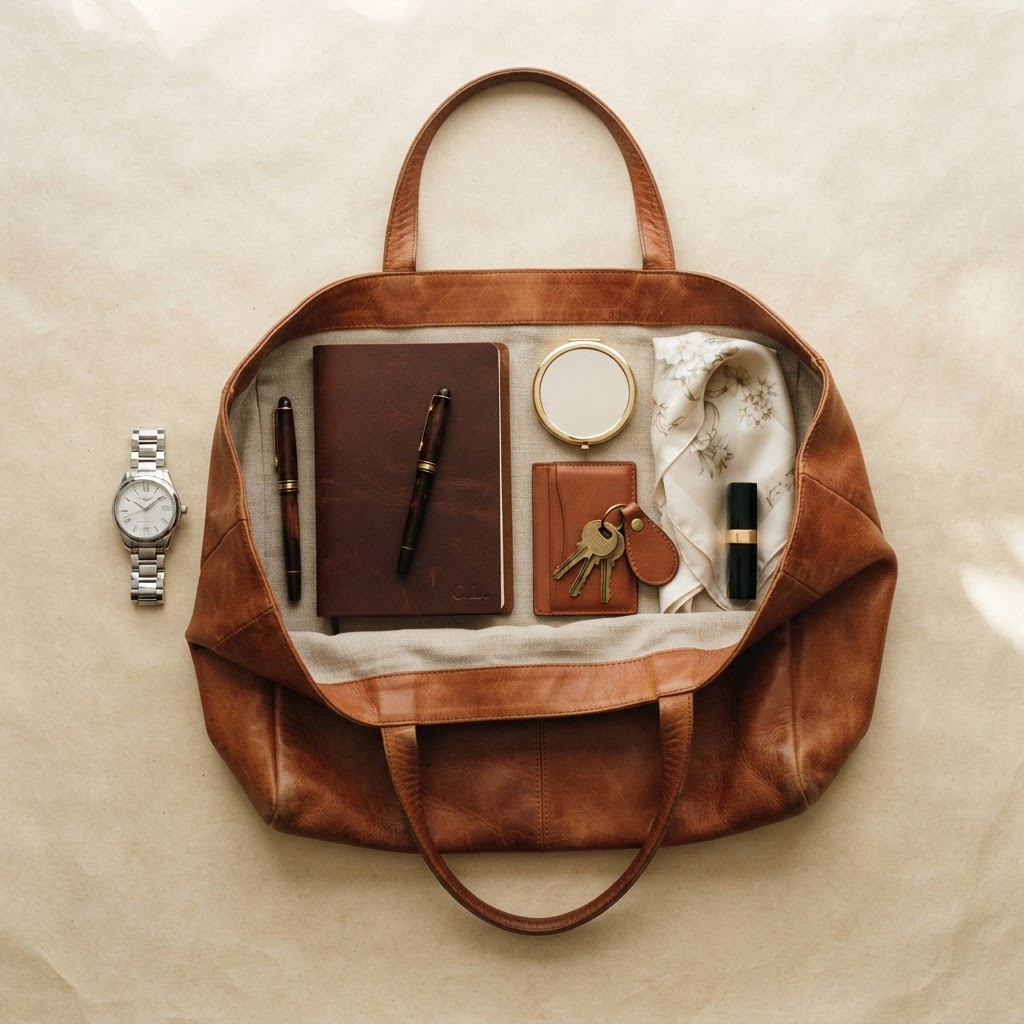
One of the first decisions you will make is whether your everyday carry lives in a bag or in your pockets. Many women default to a bag, and there is nothing wrong with that — but it is worth being deliberate.
A bag allows you to carry more, but it also creates separation between you and your tools. The most important items — your phone, your identification, your keys, and whatever you would want in an emergency — should be on your person or in a bag you carry at all times, not set down and walked away from.
I wrote about my own approach in What Lives in My Bag (And Why). The principle is simple: every item earns its place, and the system is organized so that I can find what I need without thinking.
If you carry a bag, consider keeping a smaller core kit — keys, phone, ID, one tool — in a pocket or a small wristlet. That way, the essential items are always with you even when the bag is not.
Quality Over Quantity
When you have identified the items that belong in your carry, invest in quality versions of each. This is not about spending extravagantly. It is about choosing items that will last rather than replacing them repeatedly.
A well-made leather card holder will outlast a dozen cheap ones. A quality knife will open smoothly for years. A flashlight from a reputable maker will work when you need it, not just when it is new.
Quality also means choosing items you genuinely like carrying. A tool you find beautiful and well-made is one you will use with more care and attention. That matters. The things we carry should be things we are glad to have with us.
Extending Your Carry Beyond Your Pockets
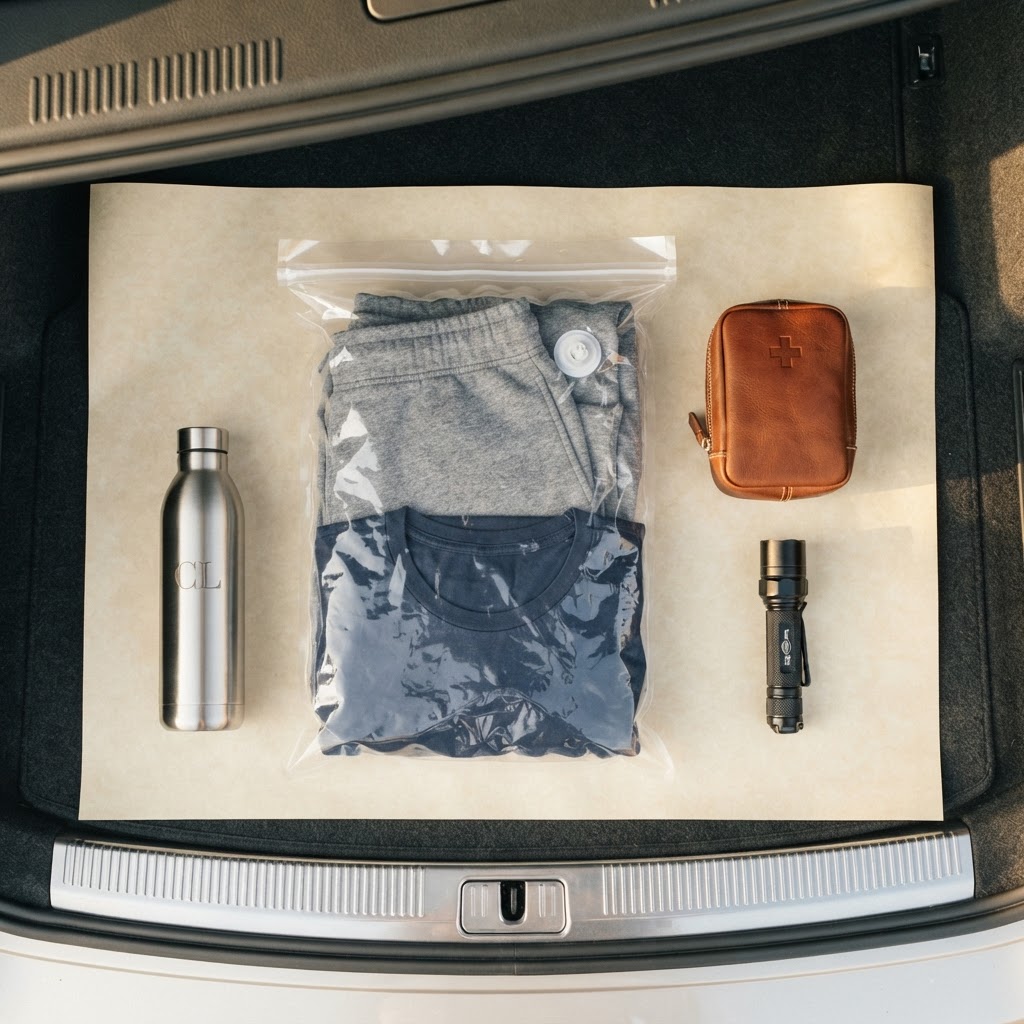
Once your personal everyday carry is established, the same principles extend to the spaces around you. Your car, for instance, is an extension of your carry — a place to keep items that support longer trips and unexpected delays without becoming a storage locker.
I wrote about this in Your Car Is an Extension of Your Carry. The same filter applies: carry what you will genuinely use, keep it organized, and resist the pull toward accumulation.
Travel is another extension. A dedicated travel system — a packed toiletry bag, a packing list, a consistent approach — means you never start from zero. A better way to pack begins with the same philosophy that guides your daily carry: intention, not excess.
A Simple Starter Checklist
If you are building your first everyday carry kit, here is a place to begin. Adjust it to fit your life.
— A slim wallet or card holder with ID, a card, and cash
— A compact flashlight
— A small, quality folding knife
— Keys with a minimalist lanyard or organizer
— A phone and a small charging cable or power bank
— A slim notebook and pen
— Two or three personal care items that matter to you
— One personal safety item, chosen thoughtfully
This is a starting point, not a final answer. Over the first month, you will discover what you reach for and what you do not. Remove what you ignore. Add what you miss. Let the kit become yours.
The Quiet Confidence of Being Ready
The purpose of an everyday carry kit is not to prepare for catastrophe. It is to handle the ordinary moments of a real day with grace and ease — to cut a tag, to find your way in the dark, to write down an idea before it disappears, to feel composed and capable wherever you are.
Preparedness, at its best, is quiet. It does not announce itself. It simply means that when a small need arises, you are ready for it. And that readiness, repeated day after day, builds a kind of confidence that does not need to be spoken.
Start small. Choose well. Carry what you use. Let the rest go.
That is how a life of quiet capability begins.
Build Your Kit
— The Covert Lady