Carry
Why I Carry a Knife Every Day(And It Has Nothing to Do with Self-Defense)
11 min read
When people hear that I carry a pocket knife every day, they often assume it's for self-defense. That's usually the first question they ask. The truth is, that isn't why it's in my pocket or bag.
In today's world, the average pocket knife probably spends more time opening Amazon deliveries than it does out in the woods. Mine certainly does. Between packages, clothing tags, zip ties, cardboard, and the countless little tasks that pop up throughout the day, it's become one of the hardest-working tools I own.
That's really why I carry a knife—not because I expect an emergency around every corner, but because everyday life constantly gives me reasons to use one. The best tools aren't always the ones that save the day in dramatic fashion. More often, they're the ones you quietly reach for over and over again without giving them a second thought.
Working in the firearms industry has reinforced something I've come to believe about almost every piece of equipment I own: tools should solve problems. They don't need to be flashy, trendy, or the newest thing on the market. They simply need to work when I need them. A pocket knife has earned its place because, unlike so many gadgets that eventually end up forgotten in a drawer, I use it almost every single day.
Most of those uses aren't exciting, and that's exactly the point. I'm opening Amazon boxes after a long day at work, cutting tags off my daughter's new clothes, breaking down cardboard for recycling, trimming loose threads before walking into a meeting, opening stubborn plastic packaging, slicing open bags of mulch in the yard, or cutting zip ties that seem to hold every product hostage these days. It may not sound glamorous, but it's practical. Those little tasks add up, and having the right tool nearby simply makes life easier.
One lesson I've learned is that there isn't a perfect knife.
Just like firearms, there are better tools for different situations. The internet has a way of convincing us that every knife needs to be oversized or built for the apocalypse. In reality, most of us aren't hiking through the wilderness every day. We're driving to work, picking up groceries, raising families, traveling, and living ordinary lives. My everyday routine simply doesn't require a massive fixed blade strapped to my side.
Over the years, my own preferences have changed.
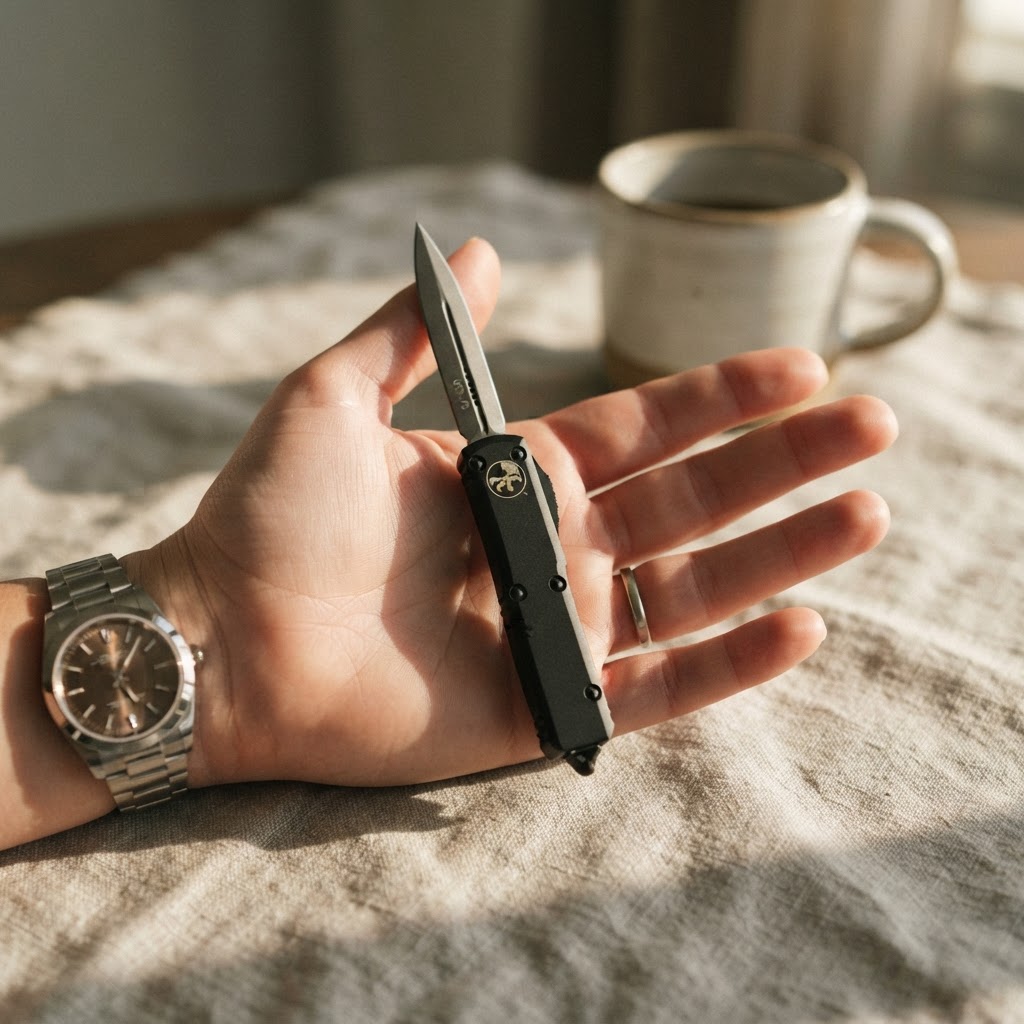
When I first started carrying a knife, I carried a traditional folding knife. It was simple, familiar, and a great way to learn how to safely handle and maintain a knife. As time went on and my experience grew, my everyday carry evolved. Today, I carry a Microtech UTX-70.
For me, the UTX-70 is the perfect balance. It's incredibly compact, disappears into my pocket or bag, deploys quickly with one hand, and handles virtually every task I ask of it. Whether I'm opening another Amazon package, cutting zip ties, or breaking down boxes, it's become one of the tools I reach for the most.
That said, I probably wouldn't hand my UTX-70 to someone who simply asked, "Can I borrow your knife?" Out-the-front knives operate differently than traditional folders, and if someone has never used one before, there's a learning curve. I'd rather avoid someone fumbling with a tool they're unfamiliar with or accidentally using it incorrectly.
For that same reason, I don't usually recommend an out-the-front knife as someone's very first everyday carry knife. A quality folding knife is often a better place to start. It allows you to become comfortable with safe handling, opening and closing the knife, sharpening, maintenance, and discovering what features you actually value before moving into a more specialized design.
There isn't a "best" knife—only the best knife for where you are in your journey. As your experience grows, your preferences may change just like mine did. The important part isn't carrying the same knife someone else carries. It's carrying a tool that fits your lifestyle, that you're comfortable using, and that you'll actually have with you when you need it.
That same philosophy applies when choosing a knife.
I don't believe in buying something simply because it's the newest release or because social media says it's the latest must-have. There are excellent knives at every price point. What matters is finding one that feels good in your hand, opens smoothly, holds an edge, and is built well enough that you can depend on it. The best knife isn't necessarily the most expensive one—it's the one you'll actually carry and use. I'd rather own one exceptional knife that I genuinely enjoy carrying than a drawer full of inexpensive knives that never leave the house. It's the same philosophy I apply throughout my life. I don't mind investing in quality if it's something I'll use regularly. Thoughtful purchases almost always outlast impulse buys.
A knife is also a tool that deserves respect.
One of the biggest misconceptions is that a dull knife is somehow safer than a sharp one. In reality, a sharp knife requires less force, gives you more control, and is often safer because you're less likely to slip while trying to make a cut. Learning how to safely handle your knife, keep it sharp, maintain it, and use it responsibly is simply part of owning it.
Just like anything you depend on, a knife deserves a little attention. Wipe it down after using it, keep the edge sharp, and every so often put a drop of oil on the pivot to keep it operating smoothly. Since I already have it on hand, I simply use a drop of gun oil. It works well, and it's one less specialty product I need to buy. A quality knife can easily last for decades if you take care of it.
Before carrying any knife, spend a few minutes learning your local and state laws. Blade length, automatic knives, and where you can legally carry may vary depending on where you live. Just like responsible firearm ownership, understanding the law is part of being a responsible knife owner. A few minutes of research can prevent a lot of unnecessary problems.
Why Not Just Use Scissors?
I've actually been asked, "Why not just use scissors?"
The answer is simple: scissors are usually sitting in a kitchen drawer, a toolbox, or back at the office. My knife is with me.
The best tool is often the one you actually have when you need it. Whether it's opening a package in a parking lot, cutting a loose thread before walking into a meeting, or freeing something from stubborn packaging, having a knife in your pocket or bag means you can solve the problem immediately instead of waiting until you get home.
I also believe there's an etiquette to carrying a knife. Mine isn't something I pull out to impress people or make a statement. If I need it, I quietly use it, fold it back up, and put it away. Most people probably never notice I have one, and that's exactly how I prefer it. Much like my philosophy on concealed carry, I don't feel the need to advertise the tools I own. They're there to serve a purpose, not become part of my personality.
Every now and then someone will notice I have a knife and ask if they can borrow it. Usually it's to open a package, cut a string, or tackle another ordinary task. Those moments remind me that preparedness isn't measured by how much gear you own. It's measured by whether the things you carry quietly improve your everyday life.
To me, that's what everyday carry is really about.
It's not about looking tactical or pretending every trip to the grocery store is an adventure. It's about quiet competence. It's about being prepared for the life you actually live instead of the one the internet tells you to prepare for.
At the end of the day, my knife isn't a symbol of toughness. It's a reminder that simple, well-made tools often become the most valuable because they're the ones we actually use. A knife is one of the few tools that can save you both time and frustration multiple times a day. It quietly solves problems, saves time, and makes everyday life just a little easier.
Preparedness isn't measured by how much gear you own. It's measured by whether the things you carry quietly improve your everyday life. My knife has done exactly that. It isn't there to impress anyone. It isn't there to make a statement. It's there because, time and time again, it has earned its place.
To me, that's what Covert Lady is all about—carrying tools with intention, maintaining them well, respecting them, and choosing quality over quantity. Quiet competence isn't about owning the most gear. It's about having the right gear, knowing how to use it, and letting it quietly make your life a little easier.
Quiet Competence
— The Covert Lady